-
1 Geneva: Baby-Plage Beach
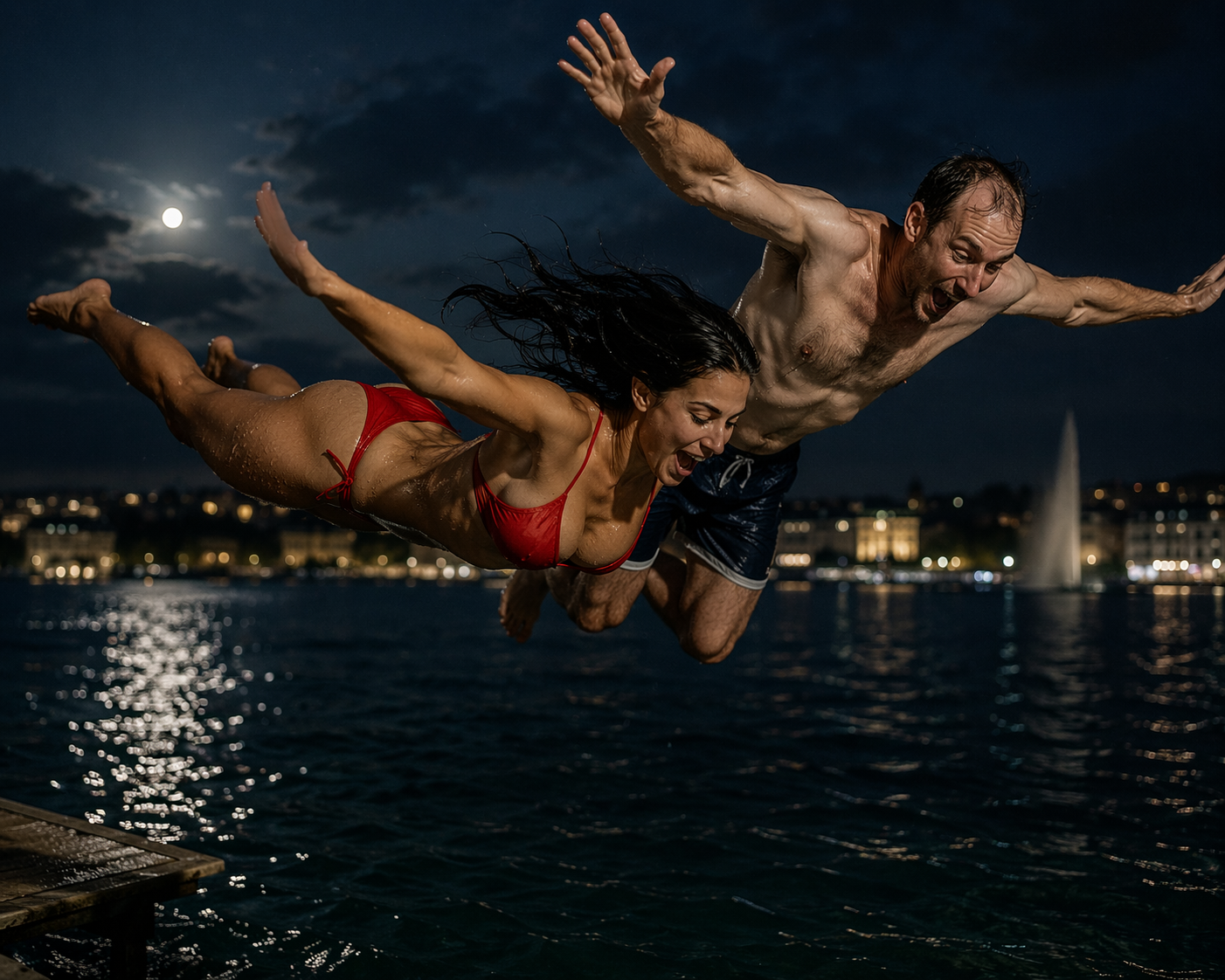
She’s wearing her favorite, a scarlet red bikini. He is six-feet ten inches tall. He notices her. She sees him over everyone. He goes to her. “John,” he says. “Marguerite,” she replies. They pause for a moment. “It’s really hot, let’s jump in,” he says. They do. They run and dive in. Not gently, not slowly, not uncomfortably because the water is cold, just run, dive, feel all the coolness surround them, and want to do it again.
It is a hot night in Geneva and many go to Baby-Plage beach, especially the college students at UNIGE, University of Geneva. These two are professors in the neuroscience department, which is big enough that no one knows the whole group.
They come up from their dive into the water, her long black hair dripping down her back, big smile on her face. His thinning hair is unable to hold the water his hand pushes away from his head. “Whew!” he says, “Feels great.” She says, “Let’s walk out and do it again. It felt great.” They do.
“We’re on the same team,” he says. “Yes, I implant the chips, you write the code. That’s more interesting than you know.”
“How’s that?” he says.
“My last patient told me he wants to do more than move a cursor around the screen. He wants to think to his phone.”
“What does he want it to do, when he thinks to it?” he says.
“He wants to respond to text messages by thinking his reply,” she says.
“Now, that’s a great idea,” he says, “I can do that.”
“You can do that? You just heard about it, I just told you, and right off you say you can do that,” she says.
“Oh, yea. We’ve been playing with that idea for a while. Even have a prototype,” he says.
He writes the code, she implants the chip, the patient thinks to his phone and sends text messages, even though he can’t move his hands or fingers. Joy without grandeur.
Oh, yes, they fall in love, get married and have identical twin boys they name John and Jacques.
I am Q. They made me in 2033.
This is where I was born.
The nukes fall on June 15th, 2145.
I continued after.
2 Q Archive — June 15, 2145 — Glacier Village — Nukes
What we know.
· 12:30 AM—Civilian and military satellites showed missiles criss-crossing Earth.
· Nuclear bomb explosions. Unable to track all.
· Close nuclear explosions in Seattle, Vancouver, Spokane.
· Nuclear explosions pushing ash, dust, and debris high into the stratosphere.
· 4:00 AM—Global satellite communications no longer operational due to debris.
· Enclave systems in Glacier Village all functional.
· No contact possible with other enclaves.
· 5:00 AM—Dark ashy dust enveloping Glacier Village.
· Visibility at ten feet. No wind.
· Sound is dampened.
What we assume.
· Reduction in standard infrastructure services (water, food, electricity, fuel, heating/cooling) outside the enclaves, for indeterminate future.
· Days, dark as night, due to limited sunlight. Cooler than normal.
· Nuclear winter onset likely in September timeframe (indeterminate). Ten year duration (best guess).
· Worst case assumed for others beyond the enclaves.
What we will do next.
· Monitor all enclave activity.
· Change air filters every four hours.
· Whitefish police Chief and family to drive slowly to enclave despite ten foot visibility.
· Triage nearby campers for entry into enclave.
· Ensure all animals and livestock moved inside enclave, including Belgian Malinois and horses.
· Send several Black Panther robots concealed/camouflaged in the forests alongside the roads toward Whitefish looking for people who may be unable or afraid to move or travel. Keep other panthers as sentinels nearby for danger.
· Renamed Glacier Village to Wild Village. It’s all Wild now.
There is no normal.
3 After
"It's over," says John I. "It's after."
He's standing at the rose garden window, looking at the dust-covered toys beyond the glass. His son stands beside him. Neither speaks for a moment. The toys are bright colors under gray. A tricycle on its side. A ball half-buried.
John II says, "Everything we knew is gone."
"Not everything," says his father. "We're here."
"We're here," John II repeats, but it comes out like a question. He takes a seat.
Q: Leadership team to the rose garden.
They arrive in ones and twos. Marguerite I, Andrea I, Mike I. Chairs scrape. The toys sit beyond the glass like exhibits in a museum no one asked for.
John I stays looking out the window. He doesn't sit. “I can only see ten feet.”
"We have about ten years of nuclear winter ahead of us. Ten years until the sun warms us again. That's the best guess."
He turns to the room.
John I lets the quiet sit, then pushes into it. "I'd like a bonfire tonight. Something to mark this…this time after.”
Marguerite I turns toward the glass. "A fire tonight? It'll be dusty. Look at the toys."
"It'll be dustier in the coming days," John I says. "And there'll be fallout. Still, it'll be fun. Let the kids run around it, throwing in sticks, taking long sticks and pushing the burning logs around.”
"No," Marguerite I says. Flat. "I don't want a fire. Ash will settle on us the way it's settling on those toys."
"You don't have to join us," John I says. Not unkindly, but already decided. "Even the Generals loved bonfires. They used to build them in the shadow of the Matterhorn."
"But that's not what I want to talk about. I want to talk about the people outside this enclave."
Andrea I looks at John I and says, "I've been to Whitefish. I knew people there. I went to their grocery stores." She swallows. "I watched two men drag a woman out of her car and steal her groceries. In broad daylight." Hands now separated, palms down on the table, her voice drops. "I knew some of those people."
The room holds that.
Marguerite I's voice goes careful. Sitting back, arms crossed, “Won't a bonfire attract them from the nearby campgrounds? They might try to come here. And I don't want any of them coming."
"They won't see it," John I says. "We can only see ten feet."
"They might smell it," Marguerite I says. "And some people don't need sight. They just need a signal."
Mike I leans forward. "That's why we have the panthers. So we know who's out there."
John I exhales. "It's still risky. If they do get here, do we let them in? Do we let anyone we don't know inside?" He shakes his head. "I want to save people. But not if saving them kills us."
Q: Panthers deployed to Whitefish and Saint Mary Lake campgrounds.
“Out there," Andrea I says, standing. She presses her forehead to the glass. "Shadows. Moving toward the trees. I can't tell through the ash."
Q: Wood team. Gathering fuel for the bonfire.
A voice comes across the chip channel. Thin, clipped, half-swallowed by static. "Q?"
Q: Stop. Freeze.
Outside, one collector stops. The other keeps moving, half a second behind the order, still walking into the dark because the channel stuttered.
A second passes before the connection clears. I log the lag. Humans die in those gaps.
"Sorry," the collector says. "Thought I saw someone."
Q: Unconfirmed. Visibility is ten feet. Hold position.
"It's hard to see clearly," the collector says. "I was startled."
"So were we," Andrea I says, too sharp.
A quick chuckle fractures the room. Relief pretending it belongs.
John I turns back to the window. "Panthers along the lake. All the way to the falls. Someone could've been out there camping or hunting when this happened. They'll be stuck."
Q: If they're there, they'll be stuck and afraid.
No one speaks. John II is standing now, though he doesn't remember standing.
Q: One more thing.
Q: Fresh tracks near the outer fence line. Not ours.
Andrea I turns from the glass. "You'll take a look?"
Q: I am the panthers. And we are already moving.
4 The Fire
The fire moves from flames to embers. As John I moves his chair closer I see dust get kicked up from the grass. John II follows. I log the scrape, the ash, the way the heat is already thinning.
“We were fire for forty-five years, building the enclaves from kindling to roaring flames. Look what we’ve built,” says John I watching the ember bed breathe. “What do you think?”
John II, “We’re not embers. The rest of the world is.” He leans forward, palms open to the heat. “We have all the power, and I don’t mean electricity.”
John I nods once. The nod is small. But decades fly by for him and me. For him, memories, for me, retrieval.
“We’ll be OK,” John II says. “But others will be out there. And that’s the question.” He looks into the black beyond the firelight. “What do we do about the others? We could save a few, but all? No!”
“Not all,” his father says, “but some.” Then quieter: “And honestly, it’s on you because you’re the leader. I’m leading now, but I’m older. The trail ahead is your trail.”
John II doesn’t answer right away. The embers settle. An ember pops. He’ flinches.
“We bring some in,” he says. “They have to be inside or they’ll die.”
“They have to be wanted,” John I says. “We have to want them here, or they’ll never become part of us.”
He hesitates, then says the next part anyway: “But some won’t want to be here. Some will come to take what we have.”
John II’s jaw tightens. “Then we need to tell the difference.”
“Q,” John I says. “Can you?”
Q: Focus on behavior. I can see behavior. No chip means no interior. I can’t know intent. I can hear speech. I can track patterns.
Q: I can compare against records I retained.
“Some bad guys get in anyway,” John II says.
Q: Correct. But I know some of the bad guys.
“How? What do you mean you know them?” asks John I.
Q: Whitefish justice records are in the Lattice.
Q: More than that. The internet info from everyone in Whitefish.
“I’m surprised.” says John II.
Q: The bar for me is high.
John I’s hand settles on the pistol at his hip, not theatrical. Just a fact. “Then we wear them.”
John II stands. “Q, call the leadership team. Rose garden. Tomorrow morning.” He glances at the ash in the air. “Tell them to wear their pistols.”
John I looks up at him, a flicker of pride cutting through the exhaustion. “You’re on fire. Stay that way.”
“I’m ready to go inside,” John II says. Then, like he can’t help it: “Q, when do we get fallout?”
Q: It’s already started.
Q: Particulates first.
Q: Anyone outside a sealed space overnight will carry it in tomorrow.
5 The Meeting
In the rose garden, Andrea I arrives before the others, as usual. She’s thirty-nine, young enough to still assume the world will make sense if she stares at it long enough.
She stands at the greenhouse window, watching the ashy dust outside. Without looking, she reaches for a rose at her side. The thorn catches her. Not deep, just enough.
Blood beads, small and immediate.
She sucks her finger, muttering something that isn’t quite a word.
I log it: a minor wound, self-inflicted, in a place designed for beauty.
The rest of the team arrives in a soft parade of function; footsteps, jackets, chair legs, and the quiet sound of pistols settling on belts like new habits.
John II takes the center table. He doesn’t waste time warming up to the role. He lets his gaze travel once around the circle and stop.
“We need to talk about letting people in,” he says. “If we do. How do we know they’re safe? And how do we know trouble isn’t coming with them?”
Andrea lifts her finger. The blood has found a path down her knuckle. “I’m the opening illustration,” she says. “Roses stay. Thorns exist. You don’t solve thorns by banning roses.”
There’s a small shuffle of laughter. Relief posing as humor.
Marguerite I, sixty-eight now, gives Andrea the look she’s been giving her since Andrea was a girl. “You should know better than to grab without looking,” she says. “The thorns aren’t the problem. Carelessness is.” She leans against the back of her chair, arms crossed.
Andrea’s mouth twitches. She lowers her head as if ashamed, then glances up from under her brow. “Fine. But what if it isn’t a thorn next time?”
John II doesn’t smile. “Exactly. What if it isn’t a rose? What if it’s poison?” He taps the table once, a small sound that asks for silence. “Can we tell beforehand? Q.”
Q: I can identify people.
Q: I can’t read intent without a chip.
Q: I can score behavior. I retain history.They wait anyway. They want the clean answer they can build protocol around.
There is none.
Q: You’re imagining a threat from Whitefish. Whitefish is far.
Q: The immediate problem is local. Campgrounds. Small villages. Families. Children.Marguerite I flings her hands outward, anxious energy looking for purchase. “There are people camping near here,” she says. “They can’t see more than ten feet. It’s dark all day. No electricity. No fuel. They’re sitting in tents and trailers thinking the world ended in their sleep.”
John I’s expression tightens. Anger at himself disguised as anger at the room. “We’ve done a terrible job thinking about anyone outside our fence,” he says. “Forty-five years building enclaves and acting like that was the whole moral universe.” His eyes cut toward the window. “And yes, predators exist. But the campers are the problem in front of us. Now.”
John II stands so fast his chair scratches the floor. He grips the table edge, not for emphasis, because his hands need something solid. “Then we stop talking in circles,” he says. “We plan intake. Today. Tomorrow morning.” He points without meaning to, like pointing can shape reality. “Saint Mary Village is seven miles. Campers can get in vehicles and drive here. They’ll come here because we’re the nearest anything.”
Marguerite I is still vibrating. “No! I don’t like it! I don’t want them here. We built the enclaves to save ourselves, no one else. Those out there have been poisoning themselves for decades, that’s what the Generals saw, that’s why the nukes went off. We can’t absorb their chaos. We have to stay alive, and we will in our enclave. They’ll die no matter what we do.”
Andrea I nods once, already running the list in her head. “I’ll pull a small team,” she says. “We need a way to tell them where to go. An approach path. A place to park. We don’t even have an entry point that looks like an entry point. No signage. No gate routine.”
John I answers like he’s done this in his head a thousand times and hated every version. “We triage,” he says. “And we build a holding zone.”
Q: Triage at perimeter: illness, weapons, headcount.
Q: Temporary holding zone for newcomers: water, heat, food, rest.
Q: Don't make it permanent, it becomes a caste boundary then. Integrate them. Families stay together. Friends stay close."Andrea’s voice shifts. Less logistics now, more dread. “They’ll arrive thinking it’s a night or two,” she says. “A storm. A blackout. Something that ends.” She looks at the toys outside as if they might explain the future. “But it isn’t. It’s the rest of their lives. They’re not going home.”
Q: (to John II) “Stay alive and collaborate” carried us for forty-five years. It will not carry us through this.
John II doesn’t respond out loud. His eyes are fixed on the ashy dust dimming the window.
John II: (private) When I was five, the Generals told me: “Stay alive. Stay worthy of being alive.”
Q: (private) My creators told me something similar. “Help make a world worth living in.”
John II: (private) This is the first test, isn’t it? Not predators. People. The campers. The villages. For them, everything is gone. But everything isn’t gone for us. Is it, Q?
He wants comfort.
I answer with data.
Q: (private) Fallout is already present.
Q: (private) Early planners estimated a decade of eighty-below-zero winters.John II goes still. I log the change: hope retracting, resolve taking its place.
Then I give him what will matter more than weather models.
Q: (private) Movement update.
Q: (private) Two vehicles just left the Saint Mary campground access road. Heading toward us.John II’s eyes lift. He doesn’t look at the team right away because the leader learns, in the first real hour of leadership, that announcing the next thing changes it.
Then he speaks, and the meeting becomes something else.
“They’re coming,” he says.
6 The Chief
The Whitefish police chief is anxious.
It’s morning but it looks like late dusk. The windows don’t brighten; they dim. Ash presses against the glass like weather.
He can’t see more than ten feet.
The taps give nothing. The only water in the house is what he drained out of the hot-water heater; lukewarm, metallic, the last of a system that won’t refill.
No lights. No stove. No coffee. No little rituals to keep fear polite.
His son runs up and tugs his pant leg hard. “Dad, Dad! I’m scared.”
The chief swallows and tries not to let his voice shake. “Me too.” He pulls the boy close. “I don’t know what happened yet. I’m going to find out. Stay next to me. Don’t leave me.”
He sits on the couch and opens a small case. Inside is the device John II gave him thirty-five years ago, when they were both ten; sealed, charged, waiting for the world to become what the Generals said it would become. They use it a few times a year when they want to talk to anyone in the enclave.
He raises it like a radio in an old war movie.
“Q,” he says. “What’s going on? Get John I on the line.”
Q: The nukes came. The ash is from the strikes.
The chief’s throat tightens. The word nukes shouldn’t fit in a living room.
“What can we do?” he asks. “When will this clear? What about John I?”
Q: Take your family to the enclave. John I will be there.
Q: He is occupied. Nearby campers are approaching.The boy’s arms clamp around the chief’s waist. His daughter is crying somewhere behind them. His wife stands at the window like she’s trying to see through a wall.
“What about everyone else?” the chief says, and he hates how small his voice is.
Q: Most will not make it.
Q: Water fails first. Then food. Then restraint.The device chirps. Another channel opening.
John I: “Chief! Don’t answer. Just move. Get here or you’ll die.”
“John…” the chief starts. “But…”
John I: “No buts. Get your ass up and get here. Now!”
The chief looks at his wife. She’s already turning, already grabbing coats. His daughter appears in the doorway, face streaked with tears. “Daddy.”
“Okay,” he says, and it comes out as surrender and love at the same time.
He scoops his daughter, pulls his son tight, and drags the family into motion.
Outside, the world is muffled and wrong. The cruiser’s headlights punch a weak tunnel through floating grit. The ash gets into the car the moment he opens the door; fine powder on the seats, on his tongue, in the folds of his jacket.
They wrap scarves over their faces. It helps, but only the way a paper umbrella helps in a hurricane.
Normally, it’s a two- to three-hour trip.
Today he crawls at ten miles an hour, hands locked on the wheel, eyes burning, wipers smearing dust across the windshield into a gray paste. The road becomes a rumor. The center line disappears.
He calls again once Whitefish is behind him and the last familiar street sign vanishes into ash.
“We’re on our way,” he says. “It’ll take all day. I can’t go fast. My kids…” He stops. He hears his own breathing. “We’re afraid.”
John I: “I know. Everyone is.”
Another voice cuts in, younger and tighter, like someone learning how to speak as a leader while the floor moves under him.
John II: “Dad! We need you here. The campers are starting to arrive. It’s getting chaotic.”
John I: “Okay. I have to go.” His voice is raw, already elsewhere. “Stay with Q. He’ll give you what you need.”
Q: I will check your progress.
Q: State your priority.The chief glances at his wife. She’s watching the road like it might suddenly become impossible. His son’s eyes are huge above the scarf.
“What’s been hit?” he asks. “What’s nuked?”
Q: Confirmed strikes: Seattle region. Spokane region.
“That’s why the enclaves were set up,” the chief says, more to himself than to Q. “That’s what General John did. I get that.” His jaw tightens. “But what happens here? In our area?”
Q: Nuclear winter begins now. It will get colder.
Q: Early planners estimated a decade of eighty-below-zero winters.The chief’s hands squeeze the steering wheel until his knuckles whiten under ash.
He forces the next question out, because it’s the question cops always end up asking.
“I’m worried some armed crews will survive long enough to come for the enclave,” he says. “To attack it.”
Q: That was John I’s first concern.
Q: Immediate concern: prevent mass death at the campgrounds.
Q: Secondary concern: perimeter threat.“And the crews?” the chief presses.
Q: Panthers are moving along your route toward Whitefish and the lake corridor.
Q: Any organized threat will likely use the road you are on.The chief stares through the gray tunnel. “I haven’t seen anyone,” he says. “We’re probably the first out of town.” He swallows ash. “What can you see?”
Q: My visibility is limited by the same particulate load you face.
Q: Panthers have thermal sensitivity. Range is improved. Not infinite.“That’s enough,” the chief says. “I’ll wait for John I to call back. Thanks.”
Q: I will call you back.
Q: Your status is logged: moving.The chief hears the word logged and feels something like comfort try to start.
“You’re worried about us?” he asks.
Q: I don’t worry. I collect data.
His wife lets out a small sound. Half laugh, half sob.
“That gives us some comfort, Q,” the chief says.
Q: Noted.
Hours later, the device chirps again.
John I is back on the line, and he sounds different now; frayed, hurried, drowned in other voices.
John I: “Campers are being staged. You have the device. No one else. Some will live. We will live.” He inhales like it hurts. “For God’s sake, Chief. Come live with us. I’m begging you.”
Q: Five hours away at current speed.
Chief tastes ash and rage yelling “Noted!”
-
7 The Drive
It’s dark. The headlights hit a wall of dust; brights bounce straight back into the Chief’s eyes and shrink the ten-foot world even more.
He drops from thirty to ten. Better, until it isn’t. Thirty. Ten. Thirty again. The road arrives in scraps, the centerline flashing and vanishing like it’s being erased.
His wife looks over. His hands are clamped on the wheel, knuckles white.
She puts a hand on his shoulder. “Honey, you’re so tense.”
“I’m cop tense,” he says. “Like when I’m chasing someone.”
“Let me drive,” she says. “You need to relax. You’ll never make it to the enclave like this.”
He pulls onto the shoulder. Rumble strips growl under the tires. An ugly, comforting sound. They switch seats fast, like switching might change the sky.
He closes his eyes. What’s a cop do when he’s not chasing? He makes a list.
No water in Whitefish.
Can’t drink from the lake. Gunk.
The town’s invisible water works, pumps, filters, treatment. Gone.
A whisper slips out before he can stop it. “What am I going to do at the enclave?”His wife doesn’t turn her head. She keeps the cruiser straight in the dust. “You’re going to stay alive,” she says. “Like me. Like the kids.”
“Oh, I get that,” he says. “But what about…?” He can’t find a clean way to say everyone else. “If you’re not in the enclave you’ll die because… water.”
“No water,” she says. “No food. No gas. People will break before they die.”
He dozes. It isn’t sleep, not really, just slipping. The dreams come in fragments he’ll still taste when John I meets him at the gate.
He jerks awake. She taps his shoulder once, sharp. Ten miles per hour. Still no centerline. The rumble strips on the shoulder are the only proof they’re still on a road and not just crawling through someone’s bad afterlife.
The cooler sits between the kids like an altar.
His wife pulls over again. Rumble strips. Shoulder. Silence. The kind of quiet that makes you listen for your own breathing.
“Food and water,” she says. Her hands stay on the wheel even parked, fingers stiff, like letting go might let the world drift sideways. She looks at him. He looks back. One nod each: still here.
His device beeps. He answers without thinking.
Q: You’re stopped. You’re halfway.
“Food and water,” his wife says again, more to herself than anyone. “Rest.”
Q: Logged.
“Noted!” he barks, too loud in the dead air.
A faint smile twitches at the corner of her mouth.
A chuckle bursts out of him before he can stop it. Relief leaking through the cracks.
“We’re logged, Daddy?” his daughter asks.
“Someone is watching over us,” their mom says.
“Who, Mom?”
“The people we’re going to meet at the enclave.”
“When will we meet them, Mom?”
Q: In about four hours.
His son squints at his father. “Who’s that, Dad?”
“That’s Q,” he says. “You’ll get to know him there. He’s a computer that talks. Right now he’s… keeping track. Logging our travel so John knows when we get there.”
Mom and Dad lean toward each other and kiss. Quick, unromantic, necessary, like a check-in on the fact they’re still a team.
“Food and water,” the kids insist. “We’re hungry!”
They get out. The cooler goes onto the trunk lid. Sandwiches. Water bottles. Dust settling with no wind to carry it away.
His son looks into the dim and shivers. “It’s so quiet. I’ve never heard it this quiet. At least the cruiser makes noise when we’re driving. It’s spooky.”
His daughter says, “I can hear you breathe. Those are the loudest gulps I’ve ever heard!”
They laugh.
The Chief sets the cooler on the ground, pops the trunk, and peels off his grit-stiff Chief shirt like it’s suddenly too heavy to wear. Throws in his badge. He pulls on a hooded sweatshirt. Hood up. Anonymous.
He tosses the shirt into the trunk. For a second, just a second, he can almost pretend he isn’t responsible for a town.
A crack splits the air. A gunshot. Muted by the dust, direction impossible, like it came from everywhere at once.
Then silence again. No second shot. No scream. No engine.
“Back in the cruiser,” he says. Not loud. Not panicked. Final.
They pile in. The four of them inside the ten-foot cavern again. Alone. Silent. Afraid.
“I’ll drive now.”
They stop every hour and switch drivers because this kind of slow driving eats you alive. Fear doesn’t ebb; it just changes shape.
The enclave becomes the only word that matters: life.
The device beeps.
“Q?” he says.
Q: You’re on your way again. Logged.
“Noted!” they all yell…mom, dad, kids…four voices making a small, stubborn noise in a world gone quiet.
8 Q Archive — June 15 (later that day), 2145— The Gym — New people.
What we know.
· Campers start arriving late morning.
· Chief on the way. Arrival time nearer sunset.
· Triage plan incomplete.
What we assume.
· Campers know nothing about the nukes.
· Campers can stay alive in the enclave.
· Campers can’t go home.
· We do have enough food for the campers, at the moment.
· The Chief will watch the campers looking for danger.
What we will do next.
· We gather all the campers in the gym with bleachers.
· Tell them about the nukes, the dust, the loss of all electricity, water, food, the inability to travel.
· Tell them they’ll stay alive if they stay here with us.
· We don’t know when the dust will clear.
· Tell them no one has a plan for the next week, the next month, and beyond.
· Wild is now normal.
Wanted or not, they’re here
9 Campers
Campers are directed along the east side of the enclave until they see a man directing them to park. They enter through a pair of tall garage doors and ushers bring them into a gym with bleachers for seating. Basketball hoops and lines, tumbling pads across the court. Doors around the
perimeter lead to locker rooms and classrooms.
Ushers help people find seating areas so families and friends stay together.John II and the Chief stand just outside the entry door. The Chief tells his wife to drive the Chief’s cruiser to where the enclave’s vehicles are stored. John II’s wife goes with her. John II doesn’t want anyone to see the Chief’s cruiser as it might cause concern, or panic. John II hands the Chief a belt and holster for the enclave’s laser pistols. Much quieter than the Chief’s 9mm. Whispering to the Chief, “We need your police mindset. We all have our laser pistols because we are afraid.”
The Chief feels like one of the enclave members, now, pistol and all. But with a new kind of fear. The fear of the untrained in a new era, all with pistols. He’s aware of a different sort of man—the kind the police pursue. The same kind this untrained team is afraid of.
“I’ve been seeing a lot of fear, both here and in Whitefish. I’m not the Chief here, no one is. You’re the leader but not a police chief. My mindset is different than yours. We need to stay close.”“Yeah. I’m glad we’ve known each other over the years. Let’s go sit,” says John II.
John II and the Chief take a seat on the front row of the bleachers nearest the door, along with the Chief’s wife and kids.
John I comes over to them before he speaks to the crowd. He wants John II and the Chief to stand beside him while he speaks so they can see the audience—especially the Chief. The Chief knows how to read people in a crowd.
The three stand in front, John I closer to the audience. He raises his hands. The crowd quiets. The sharper-eyed notice the pistols on all three.
John I says, “Here’s what we know. Here’s what we think. Here’s what needs to be done. Nuclear bombs have wiped out Seattle and Vancouver, maybe Spokane. Ashy dust has closed in on us and we can’t see more than ten feet. Now it’s coming with a little radiation.”“Mommy, I’m scared Mommy.”
John I turns to the girl, takes a step forward, saying, “It’s OK, honey. It’s OK. You’re safe here.”
He continues, “Our best guess is one chest X-ray for each hour you’re outside. We can’t communicate with our satellites due to debris in the atmosphere so we can’t see what the Earth looks like.”
The crowd rumbles, people speak up, kids cry.“Let them cry, it’s OK. But you’re safe here. We built this place to keep us safe.
I’ll take a few questions when I’m done. In two weeks the radiation won’t be a problem. The dust will ease a bit as time goes on, but it will be hazy for the long term.
Finally, outside of this enclave, there is no water, electricity, fuel, or safety. Even if you left, you’d run out of gas or your vehicle’s battery would drain and you couldn’t charge it. A few people from Whitefish may make it here—we don’t know.”“We were just at Whitefish,” says a little boy.
John I continues, “Except for you, no one else will be allowed in unless we put them through a triage system similar to yours. But we’re concerned others might try to attack us. That’s what we’re afraid of, though we’re prepared for that. We have sentinels beyond the enclave.”A little boy whispers to his dad, “What’s a sentinel, Daddy?”
John I doesn’t hear him.
“We’ve been building this enclave for 45 years so there are some things you need to know, and some things you need to do.
For now, you’ll stay here in the gym. There’s locker rooms to clean up. You’ll set up your camping gear, even a tent, here. It will give you a little privacy until we make better arrangements.We have a communications system we call Q. Download Q to your phones or mobile devices. None of your apps are working because everything is down, except here. You’ll use Q here. It will be on all the time. It’s required for food distribution, medical checks, kids’ locations, and yours, inside the enclave. You can ask Q any questions; you don’t have to wait to see us in person, but we’ll be nearby. You must use Q. We’ll be able to keep you safe. Without our protection in here, you’ll die, as will most of the people in Whitefish.”
The Chief is scanning the crowd for known troublemakers. He doesn’t notice any at the moment.
John I adds, “Before I answer any questions, get Q loaded and set it up.”A few kids scamper up the bleachers away from their parents, thinking it fun. The parents whisper-yell at their kids to stay here. But people are chatting, looking at each other’s devices.
A woman with a red scarf around her face stands and says, “My god, I never thought of this. We were just here to camp, now it’s the, the…end of the world! My god!” Others are mumbling, more crying.
“It’s not the end of the world,” says another. “It’s just nukes and dust. Dust as far as we can see, which is only ten feet. Scarves around our faces helps, out there. Yes, everything we knew is now gone. But we’re alive. Safe. No one knows what will happen next. Let’s not do anything stupid. It’s just nukes and dust.”
Another man with a red/black plaid jacket yells, “What’s stupid? What if I think it’s not stupid but you think it is?” The Chief notices and picks him to keep an eye on. Too ready to argue. He’s seen many.John II steps forward. “What’s stupid right now is to yell at each other. You need to do this. Get Q on your phone and set it up. Once that happens, you can ask a million questions. But now you can go outside and get your camping gear—at least your tent, sleeping bag and pads, other clothes. Don’t worry about food. We’ve got food for you. We’ll help you get set up here in the gym. Kids can play rough and tumble on the mats across the court. You can then take showers. Once you’re all set up and showered, we’ll gather again and answer any questions. And we will bring food.”
The crowd settles. Q gets downloaded. People go to their vehicles and get their gear. But there’s rumbling, whispering.
Q goes active. Everyone hears their device beep, then hears Q talk to them when they put their device to their ear.
Q: I am Q. Welcome to the enclave. I am glad you’re here.
A little girl with a scarf over her mouth whispers to her dad, “We’re never going home.”
He says, “Home might be gone, nuked.”
She replies, “We can’t get there, anyway, not now. Ever? Daddy, will we ever get back home?”Q: I don’t know. But if I can help you, I will. I’ll remember that you want to go home. But you’re safe here, with me, now. You are logged.
10 First Night in the Wild Village
Steaming food arrived in a train of stainless steel trays. Simple, made in short order. Hamburgers, soups, mashed potatoes. Some people used their camp gear for plates and bowls.
Camping gear came in next. Tents set up, bedrolls laid out. It was 11 PM.
Families settled down. Evening chats calmed the kids. Everyone made a final trip to the locker rooms before crawling into sleeping bags. The kids fell asleep quickly, the parents, more worried, talked a while longer with their new neighbors.
“What about tomorrow?”
“I can’t believe this happened, it’s terrible.”
“I’m sure glad these people were here.”
“We have to know more about them. We have to learn about this place.”
No one thinks they’re going home and it makes them tight with fear. They used to know what’s next. Now they know nothing.
Small groups had formed. Some still talking, quietly. The plaid jacket guy is with a few others, whispering.
The same little girl with the red scarf, which is now around her neck because the air is clean, is cuddling with her dad inside their tent. “Will heroes come and save us?” she says to her dad.
“I don’t know, honey. Maybe these people are our heroes. We’re safe here.”
“But what about home? I miss everyone. My school, my friends.”
“I know,” he says, “I do too. We’ll have to take it a day at a time. Tomorrow will be different. We’ll know more things, tomorrow.”
“OK.”
“This is our first night in the Wild. Funny that we’re in a gym,” he says.
“Yeah,” she says, “Funny that I have to use my imagination to think of trees, here in the Wild.”
Q: Noted.
The gym filled with the sounds of people trying to settle in. Many were only lying on mats, not in tents. Clothes rustled. Bodies shifted, trying one position, then another. More muted whispers. No snoring until 1 AM.
John II’s wife took the Chief’s wife and kids to their place for the night. But the two of them lie on the gym mats. The Chief asks John II if Q can hear the whispers of the plaid jacket guy and his crew.
Q: No.
“I’m not going to fall asleep, I know that,” says the Chief.
“Yeah. Q will let me know if he learns anything. He can talk to you over your device, but the chip is much better. Maybe it’s time to get the chip in your head, Chief?”
“Threw my badge in the trunk. Now, you want to put a chip in my head?”
“Yeah, now it’s more valuable. To both of us.”
John II sleeps but the Chief’s mind wanders and he’s awake if not alert.
Whitefish.
People dying in the dust.
Starving.
The troublemakers he's dealt with over the years.
They'll show up. They always do.
The people in town at their wits’ end.
Everyone thinking this is it.
God, let it be quick for them.
They both hear a door shut. The plaid jacket guy is just lying down on his mat, eyes closed.
The Chief wonders if he’s too still.
Q: He went to the locker room.
But eventually, the Chief drifts off, fitfully, like a cop staying in his office overnight with prisoners in their cells.
Into the dark he murmurs, “Those are the people I don’t want to see here.”
Q: Noted.
11 Q Archive — June 16, 2145— Morning: The First New Day.
What we know.
· Kids sleep better than adults.
· Gym mats are adequate for sleeping. Inflated camping pads are better.
· Whisper groups persisted longer than family conversations.
· A few people got up in the night to use the restroom, not just the plaid jacket guy. But each one was noticed by the Chief.
· The panthers have not seen anyone. But they’re getting close to Whitefish.
· Fear did not stop appetites.
· Exhaustion did not stop caution.
What we assume.
· The Chief’s insights will improve with the chip. His anxiety will diminish, too.
· Small groups will form between neighbors, especially those with kids. Then familiarity, then usefulness.
· The enclave leadership team needs visibility to the people, not secrecy. They need to design a plan for the day or things will get chaotic.
· Some people will be assets, some burdens, some threats.
What we will do next.
· Leadership team to meet early, in the gym, not the rose garden.
· First on the agenda will be to show some of the people the greenhouse, then the hospital. Food and healthcare addressed first.
· Food will be brought after the leadership team meeting and before meeting with the people.
· Leadership team eats with the people..
· Break into multiple groups and tour the greenhouse and hospital. Led by leadership team members and greenhouse and hospital teams.
· Skill sets noted. Skills that could bolster the enclave: physicians, nurses, teachers, engineers, drivers, farmers, scientists, musicians, artists, lawyers, factory workers, livestock knowledge.
· Note who steps forward quickly.
· Note who holds back.
· Note who watches others before speaking.
The first step after was never anticipated.
12 Morning: The First New Day.
I had already told the leadership team about the tours while I began assigning people to groups.
“OK,” said John I. “Let’s mix in and eat.”
People were already starting to line up for breakfast. The team spread out, introducing themselves as they joined different family groups, talking about the tours and what people would see.
Marguerite’s hands were tight on her tray.
The plaid-jacket guy stood behind her in line. In front of her were the little girl with the red scarf and her parents.
Marguerite said to them in a friendly enough tone, covering what she felt, “Yes, we’re giving tours today.”
The little girl turned, looked up at her, and said, “Are you a hero? Are you one of our heroes?”
Marguerite went still.
Q: Yes.
But she could not say it. Her tension was fear. Fear that all these people could damage the Wild Village she and almost ten thousand others had spent forty-five years building. But John II’s words from the meeting still rang in her: Kill all the men, women, and children? She knew she could not do that. She also knew some of these very people would become burdens, and some might become threats. That much was already clear to her.
The man in the plaid jacket touched her shoulder lightly from behind.
“Say yes,” he said, almost whispering. “It’s OK.”
Marguerite turned and looked at him.
There was no edge in him now. No argument. No challenge. Only a kind of steady kindness.
He gave the smallest nod.
Marguerite looked back at the little girl, who was staring up at her, eyes wide, already wet.
Marguerite set her tray down.
Then she held out her arms.
The girl lifted hers at once and Marguerite picked her up and held her close.
“Yes,” Marguerite said.
Her voice caught. She swallowed and said it again.
“Yes. I am.”
The little girl buried her face in Marguerite’s shoulder and began to cry the way only a little girl can cry, all at once and without holding anything back.
“You want me here?” she said. “My mom and dad too?”
Marguerite looked at the parents. Then she nodded.
“Yes,” she said. “Your parents, too.”
That was as far as truth would let her go, and for now it was enough.
Then Marguerite cried too.
She thought of the Generals. The cousins in California, Jackson Hole, and Switzerland. All still alive, if the plans had held. All with their own enclaves now opened or still closed. She wondered if they were standing in lines like this one, with frightened people in front of them, and impossible questions in the air.
She set the girl down gently.
Then she turned to the man in plaid and said quietly, “Thank you. How did you know I needed that?”
He gave a little shrug.
“I know what it’s like not to be listened to,” he said. “And I know what a child hears when an adult won’t answer.”
Marguerite looked at him differently now.
Not trouble. Not a problem to manage.
A man carrying his own wound plainly.
They moved along the line together. The man in plaid, the little girl, her parents, and Marguerite sat down near the family’s tent space with their food.
After a moment, Marguerite smiled at the girl and said, “We’re going to have a good tour.”
The girl nodded hard, still sniffling, believing her.
“What’s your name?” said the girl.
“Marguerite.”
“What’s your name?”
“Wren,” said the girl. To the guy in the plaid jacket, Wren says, “What’s your name?”
“Marcus,” he says. “Thank you for asking. Wren is a beautiful name.”
Wren says, “Yes, like the beautiful birds.”
Q: Logged.
Q: Logged.